
F*** Consultants, make a cult.
Thoughts on modern leadership in the Attention Economy

1. Introduction
For a hardware SME with limited funding, survival requires defying conventional economics. This strategic plan achieves this by transforming the company’s hardware constraints into software advantages. The approach uses Cultural Leadership to generate viral distribution at near-zero cost, and Operational Discipline to compress iteration cycles and maximise margins. Grounded in Rosing et al.’s (2011) theory of ambidextrous leadership, this strategy enables a physical product company to achieve a software-like growth trajectory.
2. Aspect I: Cultural Leadership
2.1. Memetic Leadership
Dawkins (1976) defines memes as ’units of cultural transmission’ that replicate through imitation. In attention-scarce environments, ideas that are inherently shareable (memetic) achieve distribution without capital expenditure.
Collins and Porras (1994) distinguish Core Purpose (the organisation’s reason for being) from BHAGs (Big Hairy Audacious Goals which are bold 10-30 year goals with 50-70% success probability).
BHAGs should ’excite people and create momentum’ which are inherently memetic properties. The goal must be ’clear and compelling’ and ’serve as a unifying focal point.’ This fusion of purpose and goal creates exceptional motivational power for resource-constrained contexts where the mission will substitute for higher compensation.
Transformational leaders use ’simple words, slogans, symbols, and metaphors to generate acceptance of missions’ (Bass, 1999).
BHAGs function as high-fidelity memes (Dawkins, 1976). Collins and Porras (1994) note effective BHAGs possess memetic properties. ’Make Life Multi-planetary’ versus ’Reducing the cost of rocket launches’: The BHAG is shareable. This shareability creates network effects where the customer becomes a distribution channel, achieving viral growth through social media. This is similar to how successful consumer software products scale organically through word-of-mouth instead of through artificial advertising.
For the hardware SME, the BHAG could be “make urban air quality match rural levels”. This BHAG requires credible leadership, achieved through visible personal sacrifice.
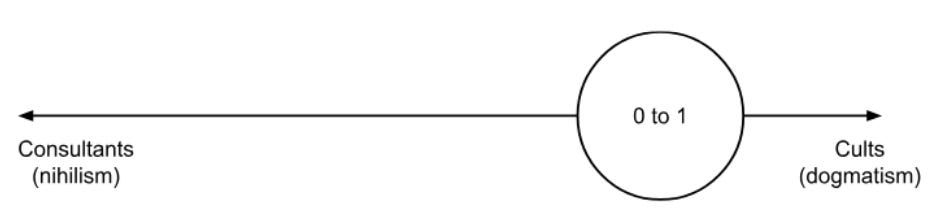
Figure 1. Company culture spectrum (Thiel and Masters, 2014). Successful startups occupy the ’cult’ end. The ideological cohesion enables experimentation within a shared purpose.
“People at a successful startup are fanatically right about something those outside have missed” (Thiel and Masters, 2014). Collins and Porras (1994) document how visionary companies maintain ’cult-like cultures’ around core ideology: “If you fit, you flourish; if you don’t, you are expunged like a virus”. This finding validates Thiel’s consultant-cult spectrum. They found “cult-like tightness around an ideology actually enables a company to turn people loose to experiment”. The SME should lead through its culture and ideas. It cannot afford to compete with salary against the incumbents.
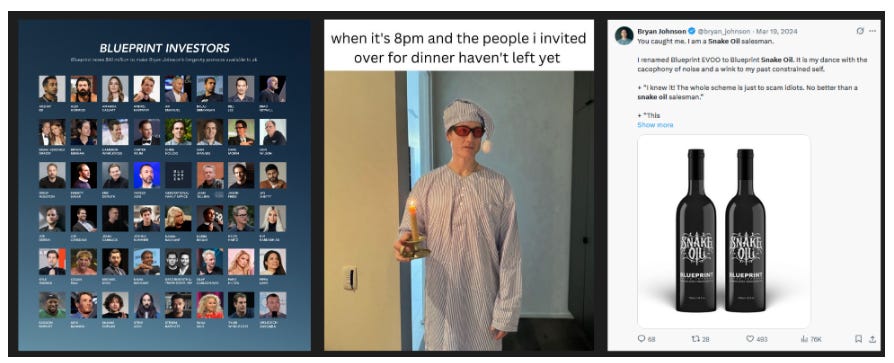
Figure 2. Bryan Johnson exemplifies extreme telic purpose leadership: “Don’t Die” mission justifies his idiosyncratic practices, creating strong in-group cohesion (Johnson, 2025).
However, such a organisational behaviour approach risks group-think and the side-lining of ethical concerns when discourse is discouraged.
2.2. Symbolic Co-suffering
Bass (1999) defines idealised influence as leaders who “set an example to be followed” and “show determination and confidence”. High intensity startup cultures become a matter of voluntary commitment, instead of exploitation, under specific conditions, where: the mission is clear before employment, and the leader’s co-suffering demonstrates authentic shared sacrifice. The participants self-select for ideological alignment and are fully aware of the demanding work environment.
This also introduces a single point of failure to the model: if employees perceive the memetic leadership as propaganda, the co-suffering as performative, or the urgency as exploitative, the intended effect reverses, causing burnout and employee resentment.
To mitigate this risk, the leader should demonstrate an authentic, genuine commitment through observable actions. Elon Musk sleeping on Tesla’s factory floor exemplifies this: his visible personal sacrifice creates cultural identification. Bass notes that this transcends self-actualisation, by pursuing “an ideal or cause that is more than oneself”. As CEO, I would hand-deliver the first 100 units. This demonstrates tangible sacrifice to the employees and customers, and showing them that the mission is real.
The success of the company should be tied to the success of the leader. Musk has zero salary as the Tesla CEO; rather his benefit is tied to the stock performance. This can also be extended to the employees with vested equity options (this also offsets a lower salary). This creates an internal company culture where the telic purpose justifies the means utilised. An authentic sacrifice will attract believers, but requires contrarian thinking to filter for those who are culturally aligned with the mission.
2.3. Thielian Contrarianism
Thielian contrarianism creates in-group / out-group dynamics where a controversial positioning attracts ideologically aligned customers. For the hardware SME, this might be shown by design choices that deliberately reject mass-market appearance and instead aim to be distinct, such as by using stainless steel as the material and not painting the frame. This becomes a strong, shareable visual identity.
However, a contrarian position limits the market size by alienating the out-group. At this scale, this is a strategic choice. The specific market is highly competitive, so trying for a mass-market solution has its own challenges, and they risk competing away their profits.
2.4. The Attention Economy
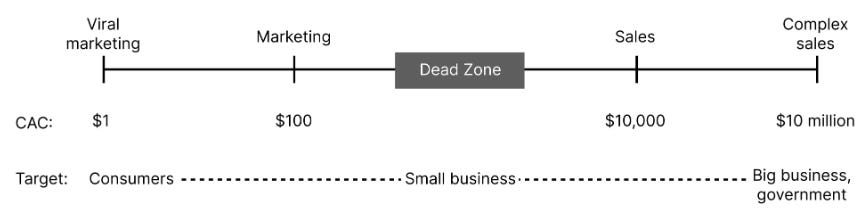
Figure 3. Thiel’s distribution scale, which shows the relationship between customer value and cost of distribution. A low-cost and high-volume product requires a viral distribution strategy (Thiel and Masters, 2014).
Nelson-Field (2020) demonstrates attention supply cannot match demand growth and traditional paid advertising becomes expensive. For SMEs, capturing organic attention through memetic content becomes necessary. Brandom (2025) documents how Roy Lee built Cluely’s distribution strategy around viral content creation, arguing that “Generally, if you’re not in deep tech, then you need to low-key deep focus on distribution,” Lee’s approach generated 1 billion views in three months through creating shareable, controversial content that spread organically across social media platforms. This exemplifies how memetic content functions as a distribution moat.
Building a personal brand on X demonstrates memetic mechanics directly: controversy and emotional resonance spread faster than nuanced analysis. This creates tension where memetic distribution may require exaggerated claims (posting “cars kill cities”, instead of “cycling is better for the environment”), but also reveals the path to software economics: attention converts to purchasing signals (waitlist signups, follows) before any mass manufacturing needs to take place. This can achieve demand validation at a near-zero cost.
Previous projects of mine have failed by assuming that growth will happen on its own. Distribution must be manufactured through a deliberate content strategy. This inverts traditional hardware economics: spend on distribution first (memetic content creation), manufacture second (only validated designs) and can achieve software-like capital efficiency where customer acquisition precedes and funds product development rather than following it.
3. Aspect II: Operational Efficiency
First-principles thinking: “First principles thinking is the art of breaking down complex problems into their most fundamental truths” (Street, 2018). For hardware, this means maximising gross margins and minimising iteration time, achieving software-like operations and learning velocity despite physical constraints. Combining this with some contrarian truth about manufacturing or technology will create a moat that competitors will struggle to replicate. They have been disrupted. The focus has shifted to streamlining internal processes instead of funding costly marketing campaigns. “Competition is for losers” (Thiel and Masters, 2014).
3.1. First Principles Execution
Validated Learning prevents waste in resource-constrained environments: Ries’ (2011) Build-Measure Learn cycle assumes rapid iteration. Hardware’s physical constraints slow this. Aspect II aims to resolve this by applying Lean principles to the manufacturing process.
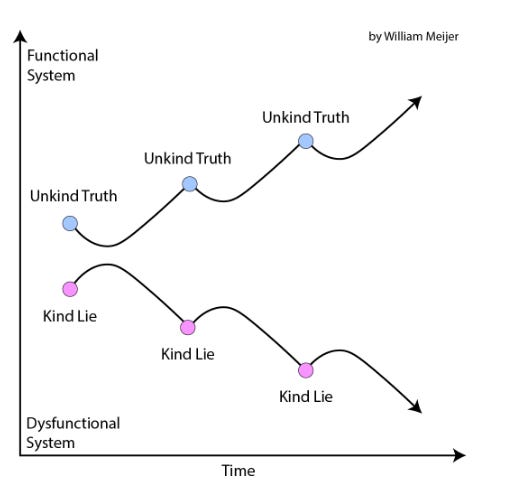
Figure 4. Unkind truths are necessary for operational efficiency (Meijer, 2025).
The algorithm Elon Musk developed when building Tesla provides the framework:
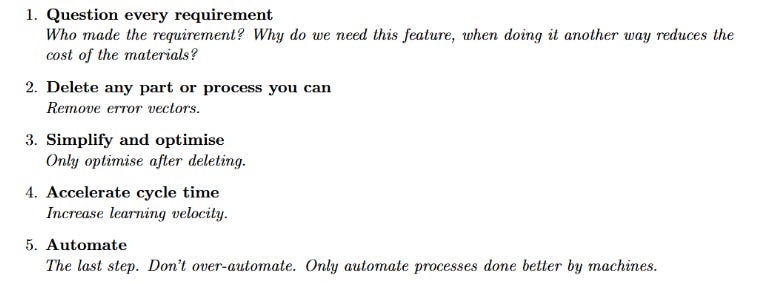
(Isaacson, 2023)
This highly structured algorithm resonates with me, as it provides a framework to channel my natural leadership preference for closing behaviours (metrics, control, and optimisation) into a productive and waste-reducing process. Musk focusses on a single metric to optimise. For SpaceX, it was “cost per ton to orbit”, for Tesla “average number of miles driven on Autopilot without human intervention”. For the SME, the single metric could be “kilometres before unit failure”.
3.2. Maniacal Sense of Urgency
A “Maniacal Sense of Urgency” drives the operational framework.
Fixed costs can be reduced by reducing the time of operations. For a startup with finite resources, time will consequently become a limiting factor. The goal should be to maximise the learning cycles (Build-Measure-Learn) before the cash runs out. Musk’s algorithm optimises the processes and his urgency optimises the time.
Musk’s algorithm aligns with my preference for maintaining control through deep technical understanding rather than trusting external expertise. However, past projects reveal this strength’s limitation: my desire for comprehensive knowledge delays action. I over-engineer solutions, seeking elegant systems when functional prototypes would validate assumptions faster. The framework’s maniacal urgency serves as a structural constraint on my natural deliberation bias.
This framework scales beyond bootstrapping. Tesla at $1.3tn market cap maintains cult-like culture, leverages Musk’s personal brand for distribution, operates with maniacal urgency achieving manufacturing speed competitors cannot match, and achieves valuation multiples a tech company would envy.
3.3. Personal leadership constraints and applications
My leadership profile favours closing behaviours (metrics, control, optimisation) over opening behaviours (experimentation, autonomy, tolerance for variance). This creates implementation asymmetry: I can execute Aspect II’s operational discipline naturally but must systematise Aspect I’s symbolic leadership through designed practices rather than charismatic instinct.
Specifically, if the increased demand for opening behaviours emerges, I will allocate that role to someone who possesses strong opening characteristics. My control orientation could suppress the experimentation necessary for innovation.
My awareness of the culture on X (formerly Twitter) demonstrates that I can build memetic content, but this differs from creating organisational cultures where others feel empowered to experiment. The SME’s success depends on whether I can share strategic control despite believing centralised decision-making produces better outcomes under resource constraints. A tension arises between my leadership philosophy and ambidextrous leadership theory’s requirements.
4. Synthesis: Software Economics Through Integrated Leadership
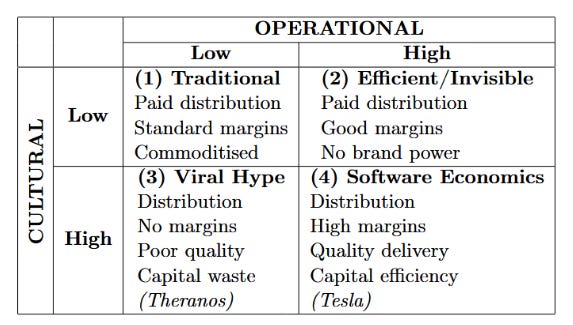
Figure 5. Strategic positioning matrix: (4) combines the two aspects, achieving software economics.
The integration of Aspects I and II creates a self-reinforcing loop: memetic content (2.4) generates waitlist signups, validating demand pre-manufacturing. Lean operations (3.1) maximise margins on pre-sold inventory. High margins fund content creation. Contrarian design (2.3) ensures the shareability of content.
Research on startup failure rates (CBInsights, 2021) suggests that such alignment is rare where 35% fail because of no market need, 38% from cash depletion. The framework outlined aims to mitigate both of these issues. This approach fails when: (1) Contrarian positioning proves too niche, (2) Founder lacks authentic belief in mission (where performative co-suffering destroys trust), (3) Online interest does not translate to product success, (4) Maniacal urgency drives key talent departure (mitigated with vested equity and mission filtering).
Bass (1999) demonstrates transformational leadership augments transactional rather than replacing it. The matrix reveals (4) as target state where memetic distribution validates demand pre-manufacturing, operational discipline prevents capital waste through Lean methodology (Ries, 2011), and combined effects approximate software economics: near-zero Customer Acquisition Cost (CAC), high margins, brand-based customer retention.
Figure 6. Opening and Closing behaviours (Rosing et al., 2011)
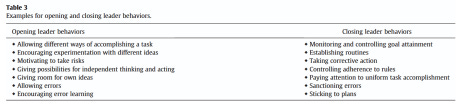
Rosing et al. (2011) argue both opening and closing behaviours must be present for innovation, requiring temporal flexibility to switch between exploration and exploitation according to innovation task requirements. Critics might dismiss this as ’Great Man’ heroic leadership. However, Rosing et al. demonstrate ambidextrous leadership derives from learnable behavioural repertoire rather than innate traits.
Jensen et al. (2023) explicitly reject individual-centric models: ’innovation leadership is too diverse to be left to single individuals; it must be embedded in the organisation.’ The framework’s founder-dependence is an acknowledged trade-off: at an SME, distributed leadership requires unavailable capital.
As such, the founder has the responsibility to create the startup’s culture (both operational and symbolic) to follow this framework if they wish for the impact of the company to go beyond selling units into the broader culture.
References
Bernard M. Bass. Two decades of research and development in transformational leadership. European Journal of Work and Organizational Psychology, 8:9–32, 03 1999. doi: 10.1080/135943299398410.
Russell Brandom. Cluely’s roy lee on the rage-bait strategy for startup mar keting | techcrunch, 10 2025. URL https://techcrunch.com/2025/10/29/ cluelys-roy-lee-on-the-ragebait-strategy-for-startup-marketing.
CBInsights. Why startups fail: Top 12 reasons, 08 2021. URL https://www.cbinsights.com/research/ report/startup-failure-reasons-top/.
Jim Collins and Jerry I Porras. Built to last : successful habits of visionary companies. Random House Business Books, Cop, 1994.
Richard Dawkins. The Selfish Gene. Oxford University Press, 1976.
Walter Isaacson. Elon Musk. Simon and Schuster, 09 2023.
Karina R Jensen, Stephanie Kaudela-Baum, and Rob Sheffield. Innovation Leadership in Practice. Emerald Group Publishing, 12 2023.
Bryan Johnson, 2025. URL https://x.com/bryan_johnson/.
William Meijer, 2025. URL https://x.com/williameijer/status/1982843284289700210.
Karen Nelson-Field. The Attention Economy and How Media Works : Simple Truths for Marketers. Springer Singapore, 2020.
Eric Ries. The Lean Startup. Portfolio Penguin, 09 2011.
Kathrin Rosing, Michael Frese, and Andreas Bausch. Explaining the heterogeneity of the leadership innovation relationship: Ambidextrous leadership. The Leadership Quarterly, 22:956–974, 10 2011. doi: 10.1016/j.leaqua.2011.07.014.
Farnam Street. First principles: The building blocks of true knowledge, 04 2018. URL https://fs. blog/first-principles/.
Peter Thiel and Blake Masters. Zero to One: Notes on startups, or How to Build the Future. Virgin Books, Cop, 09 2014.
7